
You’ve heard it your whole life. “Breakfast is the most important meal of the day.” And the classic American breakfast? Bacon and eggs. Solid. Traditional. Timeless.
Except it isn’t traditional at all.
A hundred years ago, most Americans ate a light breakfast — coffee, maybe toast or a roll. Heavy meat in the morning was unusual. Bacon and eggs became “tradition” for one reason: a man was paid to make it so.
Let me tell you how it happened. Because once you see this move, you’ll see it everywhere.
The problem: too much bacon
In the 1920s, a company called Beech-Nut had a plain business problem. It sold pork, and it had more bacon than people were buying.
So it hired a man named Edward Bernays.
Bernays is often called the “father of public relations.” He was the nephew of Sigmund Freud, the famous psychologist — and he used ideas about the mind to move products and opinions. He later wrote a book, quite openly, called Propaganda.
He didn’t try to argue that bacon tasted better. He did something far cleverer.
The move: manufactured authority
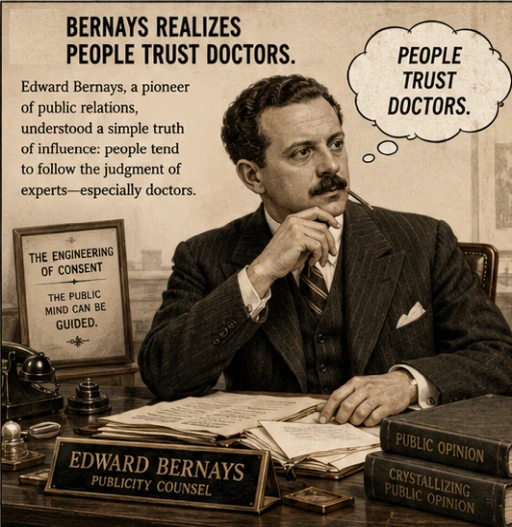
Bernays knew people trust doctors. So he used doctors.
He had a physician send a survey to about 5,000 other doctors. The question was gently loaded: since the body loses energy overnight, wouldn’t a hearty breakfast be better than a light one?
Put that way, most doctors said yes, of course. A bigger breakfast gives more energy. Simple.
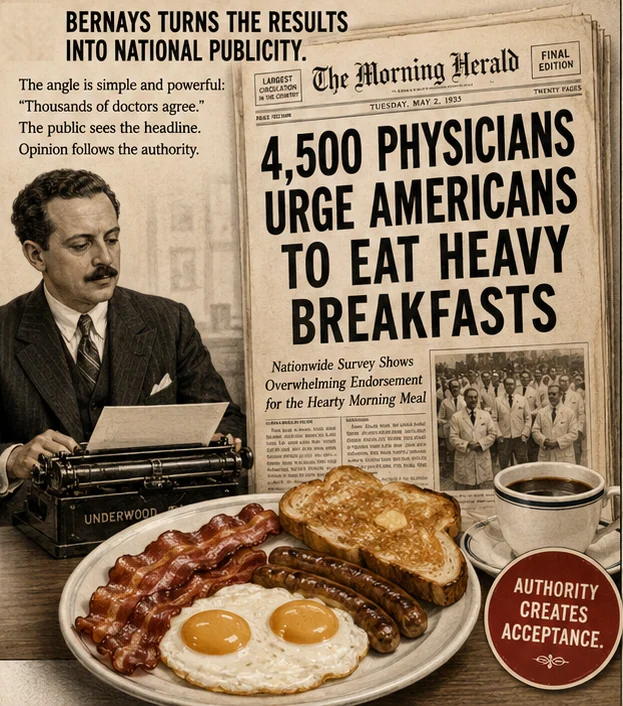
That was all Bernays needed. He took those answers and sent newspapers across the country a headline:
“4,500 physicians urge Americans to eat heavy breakfasts.”
And right beside it, a photo of the perfect hearty breakfast: bacon and eggs.
Bacon sales climbed. And they kept climbing — for a hundred years. To this day, most of us picture bacon and eggs as the “real” American breakfast.
It was never tradition. It was a campaign.
Why this is the important part
Look closely at what Bernays actually did. He didn’t improve the product. He changed the context you saw it in. He borrowed the trust you already had in doctors, and pointed it at bacon.
Now — does that remind you of anything?
It should. In another article on this site, I told the story of the food pyramid, and how sugar-industry money helped shape which science got published, using respected scientists. Same move. Different decade. Trusted authority, quietly steered, to change what a nation believed about food.
This is how food is sold to us. Not usually with a lie you’d catch — but by dressing a sales goal in the clothing of health and tradition.
I’m not telling you bacon is good or bad. That’s not the point. The point is that a lot of what you were taught to see as “just how we eat” was built by someone with something to sell.
What this means for you
Here’s the quiet weight this lifts.
If the “rules” you grew up with were often marketing dressed as health, then every time you couldn’t follow them perfectly — every time you felt you were doing eating “wrong” — you were measuring yourself against a ruler that someone bent on purpose.
That’s not a personal failure. You were handed bent rulers your whole life and asked to draw a straight line.
So maybe the goal was never to follow the rules better. Maybe it’s to see them clearly — where they came from, who they served — and then quietly decide for yourself.
That kind of clear-eyed seeing is exactly what I try to help with. And it starts with your own real day, not someone’s old campaign. But that’s a story for another page.